
Introduction
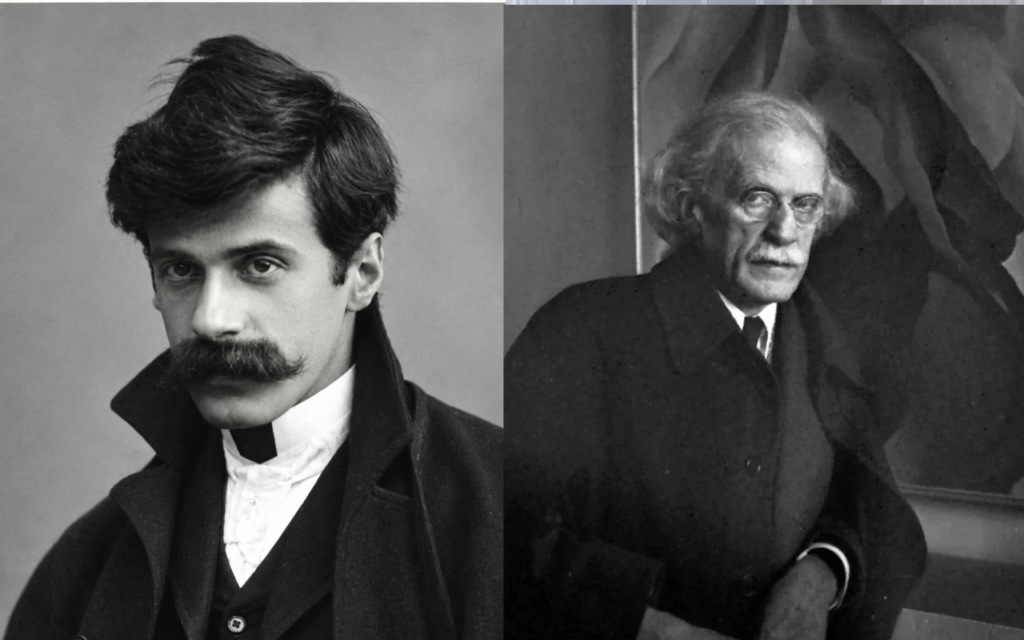
Alfred Stieglitz was one of the most influential photographers and art figures in American history. Born in 1864 and active during a period when photography was still developing as a creative medium, Stieglitz spent much of his life proving that photography could be more than a method of recording people and places. He believed a photograph could express emotions, ideas, atmosphere, and personal experiences just as painting or sculpture could. His work as a photographer, publisher, gallery owner, writer, and supporter of modern artists helped transform American art.
Stieglitz photographed New York City, nature, clouds, artists, and especially Georgia O’Keeffe. At the same time, he introduced American audiences to important European modernists and supported a new generation of American artists. His famous photograph The Steerage, his Equivalents cloud photographs, and his extensive portraits of O’Keeffe remain important examples of his artistic vision.
Early Life and Interest in Photography
Alfred Stieglitz was born in Hoboken, New Jersey, in 1864. He developed his interest in photography while studying in Berlin during the 1880s. There he studied under Hermann Wilhelm Vogel, a respected photochemist whose scientific approach helped Stieglitz understand the technical side of photography. This combination of scientific knowledge and artistic curiosity became important throughout his career.
When Stieglitz returned to the United States in 1890, he made New York City his central subject. He walked through the city’s streets carrying a camera and photographed ordinary life, transportation, architecture, workers, parks, and changing urban environments. He was particularly interested in difficult photographic conditions such as rain, snow, fog, and low light. Instead of treating these conditions as problems, he used them to create atmosphere and unify his compositions. His 1893 photograph Winter, Fifth Avenue, showing a stagecoach moving through a snowstorm, became an important early example of this approach.
His Campaign to Make Photography an Art
Stieglitz became convinced that photography deserved the same artistic respect given to painting and sculpture. At the time, many people viewed photography mainly as a technical tool for documentation. Stieglitz challenged this attitude throughout his career.
He wrote articles about photography and edited important publications, including Camera Notes from 1897 to 1902 and Camera Work from 1903 to 1917. In 1902, he also helped form the Photo-Secession, an organization of photographers committed to demonstrating photography’s artistic possibilities.
His efforts were not limited to his own pictures. Stieglitz understood that changing public opinion required exhibitions, publications, discussions, and opportunities for photographers to be seen alongside other artists. Through these activities, he helped create a stronger cultural position for photography in America.
Camera Work and the Gallery Known as 291
One of Stieglitz’s greatest achievements was the gallery he directed at 291 Fifth Avenue in New York. Officially known as the Little Galleries of the Photo-Secession, it became widely associated with its street number, 291. The gallery operated from 1905 to 1917 and became an important center for photography and modern art.
Stieglitz used 291 to introduce American audiences to modern European art. Exhibitions included artists such as Pablo Picasso, Henri Matisse, Georges Braque, and Paul Cézanne. He also supported American modernists, including Georgia O’Keeffe, Arthur Dove, John Marin, Marsden Hartley, and Charles Demuth.
During these years, Stieglitz himself produced relatively few photographs because so much of his time was devoted to Camera Work, the Photo-Secession, and the gallery. Nevertheless, his photography was changing. He increasingly moved away from the atmospheric style associated with pictorialism and became more interested in geometric structures, simplified forms, and modernist ideas.
The Steerage and His Modernist Vision
The Steerage, made in 1907, is one of Alfred Stieglitz’s best-known photographs. It depicts passengers and structures aboard a ship, but Stieglitz’s interest went beyond simply recording the scene. The photograph contains strong geometric relationships, diagonals, shapes, patterns, and contrasting areas of light and dark.
The image later became particularly important in discussions about modernist photography. Stieglitz reproduced it in Camera Work in 1911 and later in the avant-garde publication 291. The National Gallery of Art notes that Stieglitz’s understanding of the photograph developed over time, especially as his engagement with modern European art deepened.
The Steerage is important because it demonstrates how a photograph can communicate through visual structure rather than relying only on its subject. Stieglitz increasingly saw photography as a medium capable of exploring shapes, relationships, rhythm, and ideas.
Alfred Stieglitz and Georgia O’Keeffe
The relationship between Alfred Stieglitz and Georgia O’Keeffe is one of the most famous artistic partnerships in American art. Stieglitz first exhibited O’Keeffe’s work at 291 and began photographing her in 1917. Their relationship became romantic in 1918, and they married in 1924.
Stieglitz created an extraordinary photographic study of O’Keeffe over many years. The National Gallery of Art records more than 330 finished portraits in the larger body of work. He photographed her face, hands, body, clothing, and artistic environment, sometimes focusing on individual body parts rather than making conventional portraits.
Stieglitz viewed these photographs as parts of what he called a composite portrait. His idea was that a single photograph could not completely describe a person. A series of photographs taken over time could reveal different aspects of an individual’s personality and changing life. In 1921, he presented more than forty O’Keeffe photographs together under the title “Demonstration of Portraiture.”
Their personal and artistic relationship also changed over the years. Early portraits often have an intense and intimate quality, while some later images are more distant and formal. The photographs therefore provide not only a record of O’Keeffe but also a complicated visual history of their relationship.
The Equivalents and Photographs of Clouds
Another important stage of Stieglitz’s career began when he turned his camera toward clouds. Starting in 1922, he photographed clouds above Lake George, New York. He initially called these photographs Songs of the Sky and later called them Equivalents. Over the following years, he created hundreds of cloud studies.
These photographs were unusual because the clouds were not simply presented as beautiful natural objects. Stieglitz wanted them to communicate feelings and states of mind. The nearly abstract images could suggest happiness, darkness, excitement, uncertainty, or other emotions without showing a specific human event.
The Metropolitan Museum of Art explains that Stieglitz used the Equivalents to explore the idea that the content of a photograph could be different from its subject. In other words, the subject might be clouds, but the meaning could come from the emotional response created by their forms and arrangement.
This approach helped establish photography as a medium capable of abstraction. Instead of asking viewers simply to recognize what they were looking at, Stieglitz encouraged them to respond emotionally and personally.
New York, Lake George, and His Later Photography
New York remained an important subject for Stieglitz for more than 25 years. He photographed streets, buildings, transportation, parks, skyscrapers, and people while the city was being transformed by industrialization and modern technology. His photographs captured both the ordinary details and dramatic changes of urban American life.
Lake George also became increasingly important. Stieglitz spent time there at his family’s summer home and photographed its landscape, people, trees, buildings, and water. His approach to nature was different from his earlier urban photography, but he continued to look for strong compositions and meaningful visual relationships.
During the 1930s, he made a series of photographs of dying poplar trees. These images became deeply personal. The National Gallery of Art explains that Stieglitz saw the dying trees as emblems of himself, giving the photographs an autobiographical quality connected with aging and mortality.
His Later Galleries and Influence on Modern Art
After 291 closed in 1917, Stieglitz continued to influence American art through other galleries. He operated the Intimate Gallery from 1925 to 1929 and then An American Place from 1929 until his death in 1946. These galleries gave him another opportunity to exhibit and support modern artists.
His influence therefore extended far beyond photography. Stieglitz helped American audiences become familiar with European modernism while also supporting artists working in America. His gallery activities connected photography, painting, sculpture, and other forms of modern art.
His publications were equally important. Camera Work provided photographers and artists with an influential platform and helped create serious discussion around photography. Stieglitz understood that photography was becoming increasingly important to modern culture and communication.
Final Years and Lasting Legacy
Ill health forced Stieglitz to stop photographing in 1937. He continued to be involved with art and his gallery activities, but his most active period as a photographer had come to an end. He died in New York in 1946 at the age of 82.
His legacy remains especially strong because he changed both photography itself and the way people thought about it. He showed that photographs could be carefully constructed works of art capable of expressing personal feelings and complex ideas. His images of New York demonstrated the artistic possibilities of everyday urban life, The Steerage showed the power of geometric composition, the Equivalents explored abstraction and emotion, and his photographs of Georgia O’Keeffe demonstrated how portraiture could become an extended study of a person.
The National Gallery of Art’s Alfred Stieglitz collection, known as the Key Set, contains more than 1,000 photographs and provides an extensive record of his career and artistic development.
Conclusion
Alfred Stieglitz was much more than a photographer. He was an important force in the development of modern American art. Through his photographs, publications, exhibitions, galleries, and support for other artists, he helped establish photography as a serious creative medium.
His life connected photography with modernism at a crucial moment in American cultural history. From snowy New York streets and the powerful geometry of The Steerage to the intimate portraits of Georgia O’Keeffe and the abstract cloud photographs of the Equivalents, Stieglitz continually searched for new ways to make photography express more than what appeared in front of the camera. His influence can still be seen in the way photography is understood today—as an art capable of recording the world while also expressing imagination, emotion, and personal experience.