
Introduction
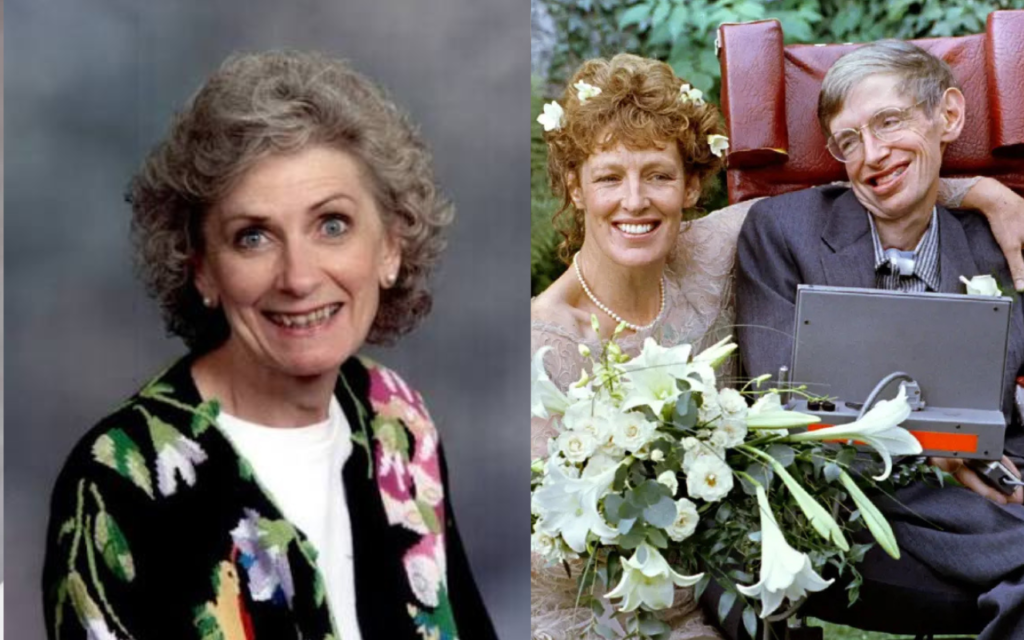
Elaine Mason is a British former nurse best known for her marriage to Stephen Hawking, one of the most influential theoretical physicists of the modern era. Her name became widely recognized after she developed a personal relationship with Hawking, whom she had helped care for as part of his nursing team. Their marriage in 1995 attracted considerable public interest because Hawking was already internationally famous for his research into black holes, cosmology, and the universe.
Mason’s life became closely connected with Hawking’s personal story, particularly during the years following the end of his first marriage. Their relationship lasted more than a decade before they divorced in 2006. During that time, the couple lived largely outside the public eye, although their marriage eventually became the subject of extensive media attention and controversy.
Despite the public interest in her relationship with Hawking, Mason’s own background remains relatively private. She worked in nursing before becoming known to the public, and she had family connections and professional experiences before her marriage. Understanding her story requires looking at her nursing career, her relationship with Hawking, the controversies surrounding their marriage, and her life after their separation.
Who Is Elaine Mason?
Elaine Mason is a British former nurse who became widely known as the second wife of Stephen Hawking. She worked as part of the team providing care to Hawking, who lived with motor neurone disease, also known as amyotrophic lateral sclerosis. The condition progressively affected his physical abilities and meant that he required extensive assistance with everyday activities.
Hawking was already a prominent scientist when Mason became involved in his care. His research helped transform scientific understanding of black holes and theoretical cosmology. His popular science book A Brief History of Time, published in 1988, introduced complex scientific ideas to a broad international audience and became a major bestseller.
Mason’s professional relationship with Hawking eventually developed into a personal relationship. They married in 1995, after Hawking’s first marriage to Jane Wilde had ended. Their relationship attracted attention because it brought together a well-known public intellectual and a nurse who had worked closely with him.
Although Mason’s name is frequently mentioned in biographies of Hawking, she has generally maintained a private public profile. Reliable information about her life outside the relationship is limited, so her biography is best understood through documented events rather than speculation about her personal circumstances.
Elaine Mason’s Early Life and Background
Compared with Stephen Hawking, whose education and scientific achievements are extensively documented, Elaine Mason’s early life has received relatively little public attention. Reliable sources do not provide a complete account of her childhood, parents, education, or early ambitions. Some online biographies give personal details that are not consistently supported by authoritative sources, so those details should be treated cautiously.
What is better established is that Mason worked as a nurse before becoming known through her relationship with Hawking. Nursing requires practical knowledge, patience, and the ability to support people with a wide range of medical and personal needs. Caring for someone with a progressive neurological condition can involve particularly demanding responsibilities because the person’s requirements may change over time.
Mason’s work placed her within a professional environment that combined medical care with technical assistance. Hawking relied on caregivers for many daily activities, while engineers and other specialists helped maintain the equipment he used to communicate and interact with the world.
Her early professional background is important because it shows that she had a career before becoming publicly associated with Hawking. However, the available record does not establish every position she held or provide a complete timeline of her nursing career.
Elaine Mason’s Nursing Career
Mason’s nursing career is central to the story of how she met Stephen Hawking. Hawking was diagnosed with motor neurone disease in the early 1960s, when he was a young man beginning his scientific career. Although doctors initially expected the disease to limit his life considerably, he lived for decades after his diagnosis and continued producing influential scientific work.
His condition gradually affected his movement and speech. In 1985, Hawking developed severe pneumonia while visiting Switzerland and underwent a tracheotomy. The procedure saved his life but left him unable to speak naturally. He later communicated through a computer-based system that converted selected words into synthesized speech.
As his needs increased, Hawking depended on a team of nurses and caregivers who supported his daily routine. Their work helped him continue travelling, attending scientific events, writing books, and communicating with colleagues. Caregiving was therefore an essential part of the practical arrangements that supported his professional life.
Mason became one of the nurses involved in his care. Over time, their relationship moved beyond the professional setting. This development eventually led to their marriage, making Mason an important figure in the personal history of one of the world’s most famous scientists.
The available public information does not provide a complete account of Mason’s training, qualifications, or every aspect of her work. Nevertheless, her nursing role is the clearest explanation of how she became part of Hawking’s life.
How Elaine Mason Met Stephen Hawking
Elaine Mason met Stephen Hawking through the nursing arrangements established to support his health and daily needs. Their connection developed during a period when Hawking’s scientific reputation was growing internationally and his personal life was undergoing significant changes.
Hawking married Jane Wilde in 1965. They had three children together: Robert, Lucy, and Timothy. Jane supported Hawking throughout much of the early part of his career, including the years when his physical condition became increasingly difficult to manage. Their marriage eventually experienced serious challenges as the demands of family life and Hawking’s care grew.
Hawking and Jane separated in 1990, and he moved out of the family home to live with Mason. The breakdown of the first marriage was later described in Jane’s memoirs, which explored the emotional and practical difficulties associated with caring for a spouse with a progressive illness while raising children.
Mason and Hawking’s relationship became personal during this period. Their connection was followed by Hawking’s divorce from Jane and his marriage to Mason in 1995. The transition attracted public attention because of Hawking’s international reputation and the fact that Mason had originally been part of his care team.
Their story also illustrates the complicated boundaries that can arise in long-term caregiving relationships. Such relationships may involve trust, dependence, and close personal contact, making them difficult for outsiders to understand fully.
Marriage to Stephen Hawking
Elaine Mason and Stephen Hawking married in September 1995. Their marriage marked a new chapter in Hawking’s personal life following his divorce from Jane Wilde. Mason became his second wife, while his three children from his first marriage remained an important part of his family history.
The couple generally maintained a relatively private household. Hawking continued to work on scientific research, publish books, travel, and appear in public. His physical limitations meant that daily life required significant planning and assistance, but he remained professionally active for many years.
Hawking’s career during this period included public lectures and popular science writing that introduced complex scientific concepts to readers around the world. His work on black holes and the origins of the universe helped make him one of the most recognizable scientists of his generation.
The marriage between Mason and Hawking lasted until 2006. Public descriptions of their relationship have sometimes been conflicting, with some accounts portraying it as passionate and others emphasizing its difficulties. Because much of their private life was not publicly documented, it is important to distinguish firsthand statements and verified events from later speculation.
The couple did not have any widely documented children together. Hawking’s three children, Robert, Lucy, and Timothy, were from his first marriage to Jane Wilde.
Controversies and Allegations During the Marriage
The marriage between Elaine Mason and Stephen Hawking became the subject of controversy during the early 2000s. Reports emerged that some people involved in Hawking’s care had expressed concerns about possible mistreatment. The concerns led to a police investigation in 2004.
These reports attracted substantial media attention because Hawking had a severe physical disability and depended on others for assistance. The situation raised broader questions about safeguarding people who rely on caregivers and about how authorities investigate concerns involving vulnerable individuals.
However, allegations must be distinguished from established findings. Hawking denied that Mason had abused him, and the police investigation was eventually dropped without charges. Public reporting does not establish that Mason was found guilty of abuse.
The distinction is important because later summaries sometimes repeat the allegations without explaining the outcome of the investigation. Doing so can create a misleading impression that the claims were proven. A responsible account acknowledges that concerns were reported, Hawking denied them, and no charges followed.
The controversy remains part of the public history of their marriage, but it does not provide a complete picture of their private relationship. The available information is insufficient to establish every detail of what occurred inside their home.
Divorce and Life After Stephen Hawking
Elaine Mason and Stephen Hawking divorced in 2006, bringing their marriage of approximately eleven years to an end. Although the separation received media attention, Mason largely withdrew from public life afterward.
Following the divorce, Hawking became closer again to Jane Wilde and their children. His family continued to be part of his public life, including events associated with the 2014 film The Theory of Everything. The film portrayed Hawking’s early scientific career, his first marriage, and the challenges associated with his illness.
Mason’s life after the divorce is less clearly documented. There is limited reliable information about her later employment, residence, relationships, or daily activities. Some online sources make claims about her current circumstances, but these are not consistently supported by dependable evidence.
For this reason, it would be inaccurate to describe her current lifestyle in detail or to claim certainty about her relationship status. The most reliable information concerns the end of her marriage to Hawking and her subsequent reduction in public visibility.
Her decision to maintain privacy has meant that much of her later life remains outside public reporting. This should be recognized as a limitation in the available biography rather than treated as evidence of any particular personal circumstance.
Elaine Mason’s First Marriage and Family
Before marrying Stephen Hawking, Elaine Mason was reportedly married to David Mason, a computer engineer. David was involved in technology connected with Hawking’s communication system, including work adapting a computer for use with Hawking’s wheelchair. Accounts of Hawking’s life describe how technological support helped him communicate after he lost his natural speaking ability.
Elaine and David Mason reportedly had two sons. However, detailed information about their children and family life is limited, and it is important to respect their privacy rather than speculate about their personal circumstances.
The connection between the Mason family and Hawking illustrates the important roles played by people beyond the scientific community. Hawking’s ability to communicate and continue his work depended on the combined efforts of caregivers, engineers, colleagues, and family members.
Mason’s family background also demonstrates that she had a life and relationships before she became widely known through her marriage to Hawking. Although these details have received less attention than Hawking’s scientific achievements, they form part of her personal history.
Reliable information about Mason’s later family relationships remains limited. Claims about her children, extended family, or current circumstances should therefore be included only when supported by credible sources.
Net Worth, Public Image, and Legacy
There is no dependable public figure that establishes Elaine Mason’s net worth. Although some celebrity websites publish estimates, such numbers are often based on assumptions rather than verified financial records. Her income, assets, and financial arrangements following her divorce have not been documented sufficiently to support a precise estimate.
Mason’s public image is closely linked to her marriage to Hawking and the controversy surrounding their relationship. This has sometimes overshadowed her nursing career and the fact that she had a professional life before becoming known to the public.
Her story also highlights the complexities of caregiving. Supporting someone with a progressive illness can involve demanding practical and emotional responsibilities. At the same time, a caregiver’s professional role should not be confused with a complete account of their personal relationship with the person receiving care.
Mason’s place in Hawking’s biography is significant because she was his second wife and had previously worked as part of his care team. However, her broader achievements and personal circumstances remain less well documented than Hawking’s scientific work.
A balanced account should therefore focus on established facts: her nursing background, her marriage to Hawking, the investigation that ended without charges, and their divorce in 2006. Other details should be treated cautiously when reliable evidence is unavailable.
Conclusion
Elaine Mason is a British former nurse best known as the second wife of theoretical physicist Stephen Hawking. She became part of his nursing team, developed a personal relationship with him, and married him in 1995 after his first marriage ended. Their relationship attracted considerable attention because Hawking was an internationally recognized scientist whose life depended on extensive assistance.
Their marriage ended in divorce in 2006. During the early 2000s, allegations of mistreatment led to a police investigation, but Hawking denied the claims and no charges were filed. Following the divorce, Mason largely stepped away from public attention, and reliable information about her later life remains limited.
Although many people know her primarily through Hawking, her story also includes her nursing career and family background. The most accurate account separates confirmed events from speculation and recognizes that some parts of her personal life have remained private.