
Introduction
The question of who is the GOAT of soccer has been debated by football fans for decades. GOAT means “Greatest of All Time,” and the discussion usually includes names such as Lionel Messi, Cristiano Ronaldo, Pelé, and Diego Maradona. Each player belongs to a different generation and achieved extraordinary things under different circumstances, which makes a direct comparison difficult.
In the modern era, Messi and Ronaldo have dominated the conversation because their careers overlapped for so many years. Their records, goals, trophies, individual awards, Champions League performances, and international careers have been compared constantly. At the same time, historical legends such as Pelé and Maradona remain essential to the discussion because of their influence and achievements at the World Cup. FIFA’s historical records show that Pelé remains the only player to win the men’s World Cup three times.
What Does GOAT Mean in Soccer?
There is no official FIFA award called the “GOAT of soccer.” The term is used by fans, journalists, players, former professionals, and football analysts when discussing the greatest players in the history of the sport. Because there is no official formula, people use different measurements when making their arguments.
Some fans focus heavily on World Cup success because the tournament represents the highest level of international football. Others consider club trophies, goals, assists, individual awards, longevity, technical ability, leadership, or performances in important matches. This explains why different generations and different groups of supporters can reach different conclusions.
The word “greatest” can also mean different things. One person may focus on statistics, another may value trophies, while another may care most about how a player influenced the way football was played. Because of these differences, the GOAT discussion is better understood as a comparison of achievements and qualities rather than a competition with an officially established answer.
Why Lionel Messi Is Part of the GOAT Debate
Lionel Messi has one of the most decorated careers in modern football. FIFA’s profile of Messi highlights his extraordinary club and international achievements, including his long career at Barcelona, his success with Paris Saint-Germain and Inter Miami, and his international trophies with Argentina. FIFA also describes him as a player with exceptional dribbling, passing, creativity, and finishing ability.
One of the biggest moments of Messi’s international career came at the 2022 FIFA World Cup in Qatar. Argentina defeated France in the final after a 3–3 draw and a penalty shootout, giving Argentina its third World Cup title. Messi scored twice in the final and won the tournament’s Golden Ball as the best player of the competition.
Messi’s World Cup record became even more remarkable in 2026. FIFA records that he finished with 34 World Cup appearances, the most in tournament history, after representing Argentina at six editions. He also finished the 2026 tournament with 21 World Cup goals, making him the competition’s all-time leading scorer at that point.
His World Cup career also includes another unusual achievement. FIFA records Messi as the only player to have won the World Cup Golden Ball twice, doing so in 2014 and 2022.
Why Cristiano Ronaldo Is Part of the GOAT Debate
Cristiano Ronaldo represents another type of extraordinary football career. His case is strongly connected to goalscoring, physical preparation, longevity, Champions League success, international football, and his ability to remain productive across multiple generations.
Ronaldo’s career has included major periods with Sporting CP, Manchester United, Real Madrid, Juventus, and Al Nassr, as well as a long international career with Portugal. His playing style developed significantly over time. Early in his career, he was known for explosive dribbling and speed, while later he became increasingly focused on movement, positioning, finishing, and aerial ability.
His international career is particularly notable for its longevity. Ronaldo appeared at six World Cups, matching Messi’s total. FIFA records that Ronaldo finished with 27 World Cup appearances.
The 2026 World Cup added another record to Ronaldo’s career. FIFA reports that he became the first male player to score at six different World Cups. He scored at every edition from 2006 through 2026, creating a record based on consistency across two decades.
This is an important part of the GOAT discussion because it demonstrates how long Ronaldo remained capable of scoring on football’s biggest international stage.
Pelé and the Historical GOAT Debate
Any serious discussion of the greatest soccer players must include Pelé. The Brazilian superstar played during a different era, but his achievements at international level remain unique.
Pelé won the FIFA World Cup with Brazil in 1958, 1962, and 1970. FIFA confirms that he remains the only male player to win three World Cup titles.
His first World Cup victory came when he was only 17 years old. Pelé scored twice in the 1958 final against Sweden and immediately became one of the most famous players in world football. Four years later, Brazil won again in Chile, although Pelé’s tournament was shortened by injury.
In 1970, Pelé helped Brazil win another World Cup in Mexico. That Brazilian team is remembered as one of the most celebrated sides in football history. Pelé scored four goals during the tournament and also provided important assists, including one for Carlos Alberto in the final.
Pelé’s era was very different from the modern game, which makes statistical comparisons with Messi and Ronaldo complicated. However, his three World Cup titles provide a unique part of the historical record.
Diego Maradona and His 1986 World Cup
Diego Maradona is another central figure in the GOAT discussion. His greatest international achievement came at the 1986 World Cup in Mexico, where Argentina won the tournament.
Maradona’s 1986 campaign is remembered for his extraordinary individual performances. Argentina defeated England 2–1 in the quarter-final, with Maradona scoring two of the most famous goals in World Cup history. One became known as the “Hand of God,” while the other involved a remarkable solo run through the England defense.
Maradona also scored twice against Belgium in the semi-final before Argentina defeated West Germany 3–2 in the final. FIFA records that Maradona was awarded the Golden Ball as the tournament’s best player.
His World Cup legacy is particularly connected with his ability to influence matches individually. FIFA’s comparison of Maradona and Messi notes that both Argentine No. 10s won a World Cup and reached another final, although they achieved those milestones in different eras.
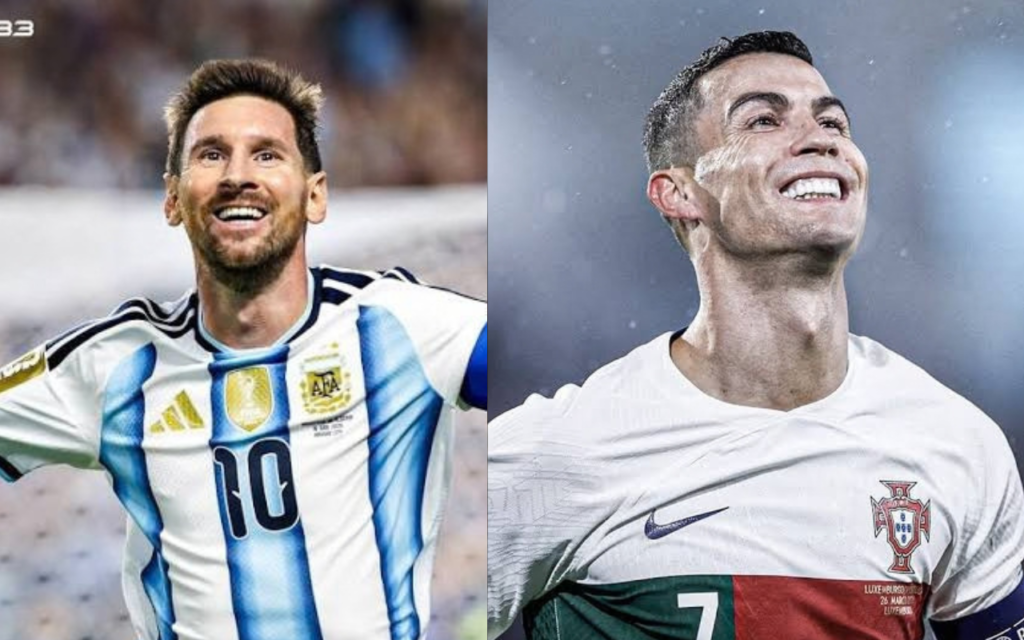
Messi vs Ronaldo: A Different Kind of Comparison
The Messi versus Ronaldo debate became one of the defining sporting discussions of the 21st century because the two players competed during the same era and were repeatedly compared at club and international level.
Their playing styles are noticeably different. Messi has traditionally been associated with close control, dribbling, passing, playmaking, and creating chances for teammates. Ronaldo developed from a wide attacking player into one of football’s most prolific penalty-area finishers, with heading, positioning, shooting, and movement becoming major parts of his game.
Their international World Cup records also tell different stories. Messi finished with 34 appearances and 21 goals, while Ronaldo finished with 27 appearances and became the first player to score in six World Cup editions.
Messi also won the World Cup with Argentina in 2022, while Ronaldo did not win the tournament with Portugal. At the same time, Ronaldo’s six-edition scoring record is unique and reflects his extraordinary longevity at international level.
The comparison therefore depends heavily on what a person considers most important when discussing greatness.
World Cup Success and Why It Matters
The World Cup has an unusually important place in the GOAT conversation. Unlike club football, players have limited opportunities to compete in the tournament because it is held every four years.
For Messi, the 2022 World Cup changed an important part of his international career. Argentina’s victory completed his collection of major international achievements and gave him the trophy that had previously remained outside his résumé. FIFA describes Argentina’s 2022 triumph as its third World Cup success after victories in 1978 and 1986.
Pelé’s three World Cup titles remain the unique benchmark for individual World Cup victories. Maradona’s 1986 campaign remains one of the most influential individual tournament performances, while Messi’s 2022 victory and later World Cup records created another major chapter in the history of Argentina’s No. 10 shirt.
Ronaldo’s World Cup record is different. His career demonstrates remarkable longevity and consistency, particularly because he scored in six separate editions.
These achievements cannot easily be reduced to one statistic. Winning the tournament, scoring goals, creating chances, leading a team, and maintaining elite performance over several tournaments are different accomplishments.
Club Football, Goals, Trophies and Individual Records
The GOAT discussion is not limited to the World Cup. Club football represents most of a professional player’s career, making domestic leagues and continental competitions important parts of any comparison.
Messi’s club career with Barcelona produced numerous domestic and European trophies, while his later years at Paris Saint-Germain and Inter Miami added further achievements. FIFA’s 2026 profile credits Messi with 40 club trophies and highlights his long list of individual and team accomplishments.
Ronaldo’s club career is similarly extensive, with major success in England, Spain, Italy, and elsewhere. His record in European club football, particularly the UEFA Champions League, is one of the central reasons he remains part of the GOAT conversation.
Individual awards also contribute to the discussion. Messi has won the Ballon d’Or eight times, while Ronaldo has won it five times. Such awards are based on voting and reflect how players were evaluated during particular periods rather than providing a mathematical definition of the greatest player ever.
Goals provide another major measurement. Ronaldo has built one of the highest recognized senior scoring totals in men’s football, while Messi combines prolific scoring with a major creative and playmaking role.
Why Comparing Different Generations Is Difficult
Comparing Pelé, Maradona, Messi, and Ronaldo is difficult because football has changed dramatically. Players from different decades faced different tactical systems, pitches, training methods, medical support, travel schedules, equipment, competition structures, and rules.
Pelé played during an era when substitutions, sports science, television coverage, and tactical approaches were very different from today’s game. Maradona played in another period with its own physical and tactical demands. Messi and Ronaldo competed during an era dominated by highly organized pressing, advanced analytics, specialized training, and global club competitions.
This means statistics should be placed in historical context. A goal total from one era cannot automatically be treated as directly equivalent to a goal total from another.
The same issue applies to trophies. The number of international tournaments, club competitions, and matches available to a player has changed over time.
For this reason, a GOAT discussion is more useful when it considers achievements within their historical context instead of treating every statistic as directly interchangeable.
So, Who Is the GOAT of Soccer?
There is no official answer to the question “Who is the GOAT of soccer?” The strongest historical discussion includes several players whose careers represent different forms of greatness.
Pelé’s case is strongly associated with his three World Cup titles, a record no other men’s player has matched. Maradona’s legacy is closely connected with his extraordinary 1986 World Cup campaign and his influence on Argentina’s second World Cup triumph.
Messi’s résumé includes the 2022 World Cup, two World Cup Golden Balls, six World Cup appearances, 34 World Cup matches, and 21 World Cup goals.
Ronaldo’s résumé includes six World Cup appearances and the unique record of scoring in all six editions.
The answer therefore depends on the criteria being used. Someone emphasizing World Cup titles may focus heavily on Pelé. Someone emphasizing a legendary single tournament may look closely at Maradona’s 1986 campaign. Someone emphasizing modern all-around production may examine Messi’s combination of scoring, assists, trophies, and longevity. Someone emphasizing goalscoring, physical development, longevity, and international consistency may focus heavily on Ronaldo.
The GOAT debate remains open because football greatness is not measured by one universally accepted statistic. Instead, it is built from achievements, performances, longevity, influence, records, and the historical context in which each player competed.
Conclusion
The question of who is the GOAT of soccer has no universally accepted answer, but the debate has produced one of the most fascinating comparisons in sports history. Pelé, Diego Maradona, Lionel Messi, and Cristiano Ronaldo each created extraordinary careers in different football eras.
Pelé’s three World Cup victories remain unique. Maradona’s 1986 World Cup campaign became one of the defining individual performances in tournament history. Messi won the World Cup in 2022 and later finished his World Cup career with 34 appearances and 21 goals. Ronaldo completed six World Cup appearances and became the first male player to score in six different editions.
Rather than being settled by one statistic, the GOAT discussion continues because fans value different aspects of football. Goals, trophies, creativity, longevity, World Cup performances, club success, individual awards, and influence can all form part of the conversation.
That is ultimately what makes the question so interesting. The history of soccer contains several players whose achievements are extraordinary, and comparing them requires understanding both the numbers and the different eras in which they played.